Bob Jones leaves behind an amoozing legacy at Jersey Dairy
At the age of nearly 80, Jersey Dairy marketing director Bob Jones is retiring, having helped exports grow from 70,000 litres in 2011 to nearly five million this year. He spoke to Alasdair Crosby at the JEP.
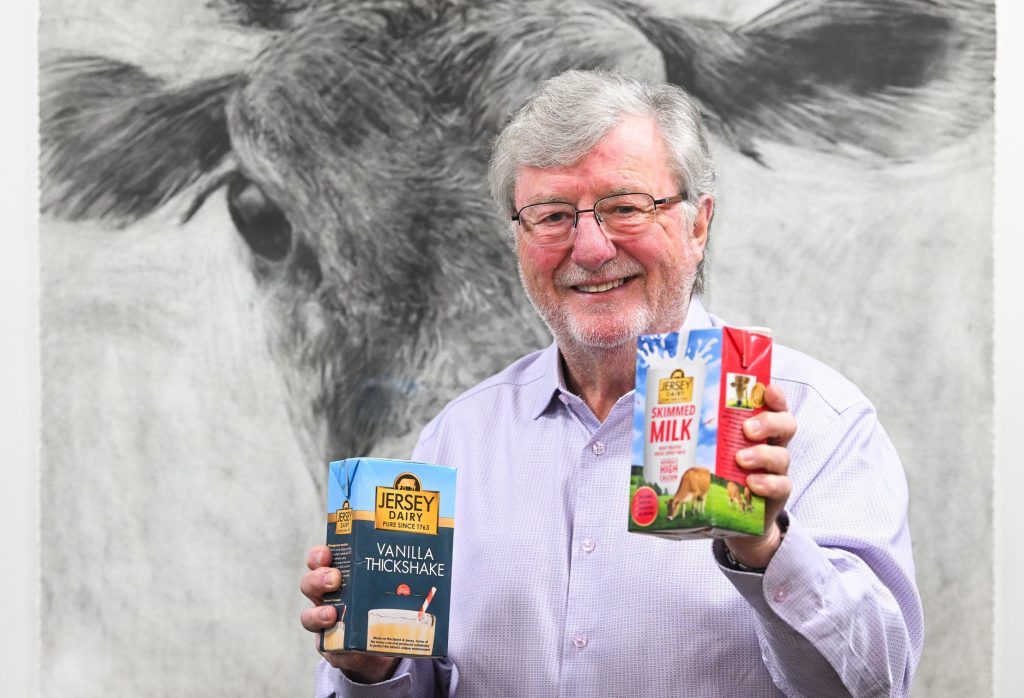
Bob Jones is retiring after 15 years at Jersey Dairy. Picture: Rob Currie, JEP.
BOB JONES, marketing director at Jersey Dairy, is retiring (again) this month, just short of his 80th birthday.
He retired from the Overseas Trading Company (OTC) in 1992, where he was a regional sales manager handling a number of their overseas markets. Then he joined Channel Television Group as their marketing director and spent seven years there. Afterwards he joined Jersey Post as the group marketing director. Aged 65, he retired.
Bob takes up the story: “Then I took a phone call from John King, whom I’d known from OTC days and who had been its managing director in Jersey. John was a non-executive director of Jersey Dairy. He told me that a new factory had just been opened in Trinity. The farmers wanted to produce more milk and this new factory had much greater capacity.
“The problem was that the local market was at best static, or rather in slight decline and therefore, there was a need to expand exports and, given my background in the export of consumer products, I was considered to be the right man for the job.
“The idea was possibly for a six-month to a one-year contract. Fifteen years later I am retiring – finally.”
When Bob joined Jersey Dairy, exports were less than 5% of revenue and today they are over 40% of revenue – something that was very necessary if dairy farmers were to remain viable and able to make a sustainable business for themselves.
The export market is thriving this year. For the first time Jersey will export almost as much milk and dairy products as are used locally, mainly in the form of soft-mix ice cream and milk shakes.
“In 2011, when I joined Jersey Dairy, it exported 70,000 litres of UHT (ultra-high temperature) milk. In the year to 30 September 2025, this grew to 4.88 million litres.”
The new Jersey Dairy factory was opened in September 2010 by the Princess Royal. Bob started work at the beginning of 2011, and with the advantage of his previous distinguished sales and marketing career, began looking for export opportunities in the Far East, in Hong Kong and China.
How can such short-life products as milk, butter and ice cream survive a long journey to the other side of the world without going off?
“The cornerstones of our export businesses are UHT milk, recipe-based products and frozen ice cream. UHT milk is milk that has been sterilised by heating it to a high temperature for a few seconds to kill bacteria and other micro-organisms. This process extends its shelf life for a year, allowing it to be stored at room temperature until the package is opened. Once opened, UHT milk must be refrigerated and has a shelf life similar to fresh milk.
“But UHT milk has facilitated the amazing export success of the Jersey Dairy. A shipment leaves Jersey for our warehouse in the UK, and then goes by ship for a six-week journey to the Far East. Frozen products, like ice cream, have a shelf life of two years. So the distance is no barrier really, and we can take advantage of the real appreciation there for British produce, which appears really safe and healthy; a consumer product that hails from a green and pleasant land, far, far away.”
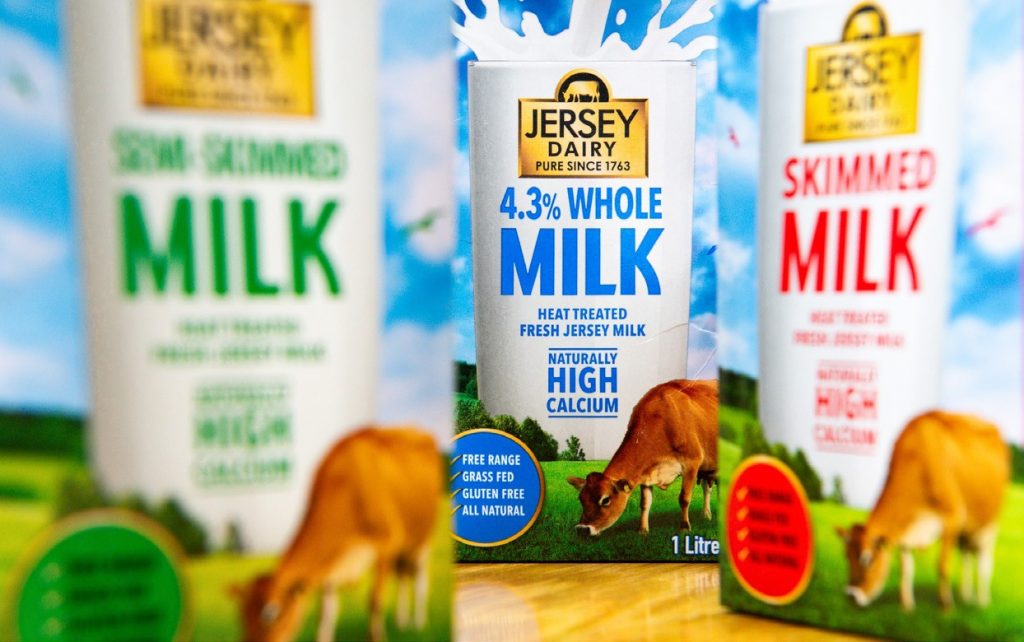
One of the cornerstones of Jersey Dairy’s export businesses is UHT milk. Pictured left: Semi-skimmed milk, 4.3% whole milk and skimmed milk in heat-treated packets Picture: Rob Currie, JEP
Initially Bob opened up a market for Jersey milk and butter in Hong Kong and then for ice cream in China. There was immediate sales acceptance for Jersey dairy products, and he was told by a supermarket buyer that that “Jersey milk was reassuringly expensive” – a remark that would warm the heart of any salesman.
“I always remember my first meeting with a very large Chinese company at their headquarters in Shanghai, who were interested in being the exclusive distributor of Jersey ice cream in the Chinese mainland market. It took place at their headquarters in a huge tower block, on something like the 58th floor.
“I was shown into a meeting room where there were 14 Chinese people, including their lawyer. I was on the other side of the table together with their purchasing director, who could speak very good English. He interpreted everything to me, because all the others were speaking in Mandarin. And I thought to myself: ‘Do these people think that the Jersey Dairy is a company like Coca Cola, for them to turn out their top brass to meet me and to discuss the procurement of Jersey dairy products?’
“Anyway, we did the business. It lasted a few years and then the company actually was overtaken by a larger group based in Singapore. We withdrew from that market, but we’ve maintained very good market share in Hong Kong.”
One of Bob’s final business trips was to Hong Kong and South Korea, from where he returned just a couple of weeks ago. The sales interest in South Korea, he said, would be another big development for the dairy.
“We shall be launching our milk into that market and it’s with a very dynamic company. Prospects look very good in 2026.”
In recent years the focus has been more on the UK market. The Jersey Dairy has been dipping into the latest catering and hospitality sector, QSR (meaning Quick Service Restaurants) and casual dining.
New customers for Island dairy produce have included Nando’s, the South African multinational fast-food casual restaurant chain, and Popeye’s, the American fried chicken chain, which refer to themselves as being the upmarket KFC. There are a number of other customers in that sector, that offer quick service, casual dining.
The Jersey Dairy has also become a supplier to Hotel Chocolat of Jersey ice cream, which is marketed by them as “the ice cream of the Gods”. Hotel Chocolat has now been bought by Mars, but continues to use Jersey dairy ice cream throughout its chain of shops.
Yet another market has been established in the EU, with a warehousing operation in Lyon, which will give access for the Dairy to some of the European mainland markets.
“We are finding that shipping into France via St Malo is getting much easier. So I think that in the future there will be a lot of our exports going south as opposed to north.
“We have a warehouse in Portsmouth, and we already deal with a logistics partner in St Malo, but now we have a distribution partner in Lyon.”
It will be not so much milk that Jersey will be selling, as soft ice cream and milkshake, and then probably iced coffee and chocolate milk, both made from UHT.
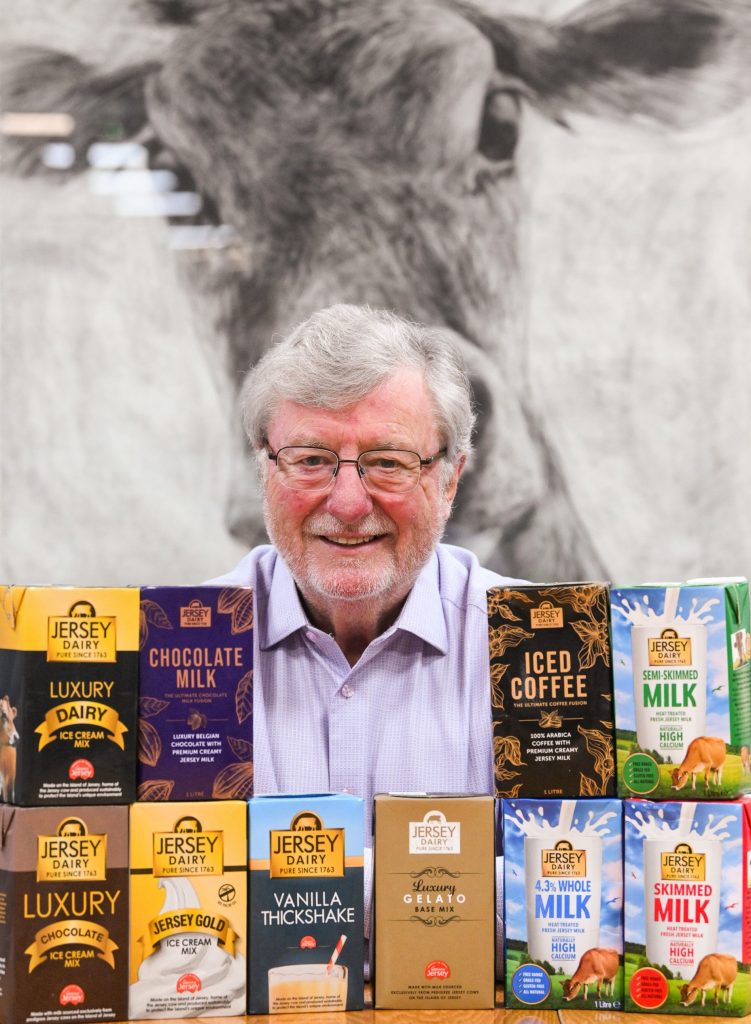
Bob with some of Jersey Dairy’s export products. Picture: Rob Currie, JEP
Bob continued: “Jersey milk from the Island is recognised as being probably the premium milk among a number of international brands. That is despite our limited capacity and that our product is predicated on being from Jersey cows on farms in the Island of Jersey. That means that there is a limitation on the number of fields and milk supplies that are available. But if people moan about the price of milk in the Island, remember that in Asian markets, consumers will be paying a retail price of around £3 to £4 for a carton.
“It’s these overseas sales that have actually been very helpful in keeping our domestic prices as low as they are. The export sales volume has sustained the local pricing.”
But milk retail prices in Jersey are more expensive in the UK?
“We’re not comparing like with like. There is milk in the UK made from Jersey herds there, such as Graham’s Dairy. But when this is on the shelves at Sainsbury or Tesco, it always commands a premium price over what one might call ‘regular milk’ from the black and white Holstein breed. That is also obviously an unfair comparison. If people complain that they pay too much for milk in Jersey, compared to the UK, they need to be reminded that you can’t compare a fine white wine to a basic plonk, and wonder why the fine wine costs more.”
Bob’s family were Welsh, but he grew up in Worcestershire. He graduated from university with a degree in politics and economics and then started work in 1968 with Procter and Gamble, the giant American consumer goods corporation, as a management trainee.
He stayed with them for a number of years, and then came to Jersey in 1985, as a J-Category Essential Employee, for the Overseas Trading Corporation, where he was a regional manager handling a number of markets; in those days the company used to export tea to over 70 countries worldwide.
When that business moved to the UK, he was asked to move back with the company, but he had settled well into Island life and his children were both well established in Island schools, so he stayed.
Afterwards, at Jersey Post, he managed what was, for a time, the major industry of low-value consignment relief; Play.com and Amazon were huge customers.
It was probably the most successful trading period of Jersey Post until the taxation rules in the UK changed, and the business dwindled away.
So, at the age of 65 he thought he had retired, and then came that telephone call from John King, and 15 years at the Jersey Dairy ensued.
“Over the last decade Jersey Dairy has been leading export growth from Jersey. We have a sophisticated manufacturing unit, and over the time that I’ve been here, we’ve developed skills in supply chain management and in the logistics of supplying overseas markets.
“The Jersey Dairy is a nice friendly place to work. I shall miss my colleagues; it’s like working in a family business. And I’ve enjoyed working with all the farmers. I really appreciate how tough being a dairy farmer is. I never complain now about meeting a tractor in a narrow lane, considering the job these guys have to do.”
As retirement beckons, what now is on the agenda?
“I have always enjoyed playing golf; I’m a member of the Royal Jersey Golf Club, which is a nice, friendly club. I’m going on my first golf tour with some members in March, off to Morocco. It is something to look forward to, and something now that I shall have some time to do and enjoy.
“Yes – travelling, again, I suppose. But now it will be for pleasure, not business – and from now on I won’t need to leave my wife at home!”